Pool Hashrate vs Network Hashrate: Which Number Predicts Your Income
One of the two numbers predicts your income and the other only predicts its shape. Network hashrate — about 1,003 EH/s at the time of writing — is the denominator that converts your machines into a share of the 450 BTC the network produces each day, and that share sets your expected income. Pool hashrate tells you how often that income arrives. A 250 TH/s setup earns the same expected 0.000112 BTC a day in a pool of any size, roughly $9.50 at a $84,692 BTC price, but the payout rhythm is not the same.

Key takeaways
- Your expected income is your hashrate divided by network hashrate, times the 450 BTC mined daily, times one minus the listed fee. Pool hashrate does not appear in that formula.
- A pool's share of the network changes variance and nothing else: 250 TH/s earns the same expected 0.000112 BTC a day in a large pool or a small one, delivered in more, smaller slices when the pool finds blocks more often.
- Scale compounds fast: 50 TH/s needs about 222.7 days at current difficulty to produce 0.005 BTC, while 4 PH/s needs about 2.78 days.
- Two settings do change the expected amount, both on the fee side: a listed 4% on the PPS-settled block reward and 2% on PPLNS-distributed components under PPS+, or a listed 2% across the board under PPLNS.[1]
Definitions first
Network hashrate is the total computational power pointed at a chain, currently around 1,003 EH/s. Difficulty, at 132.76 T, is the same fact expressed as a target: it adjusts so that blocks keep arriving roughly every ten minutes no matter how much hardware joins. With a 3.125 BTC subsidy and 144 blocks a day, the network issues about 450 BTC daily, and every miner's expected income is a slice of that pot proportional to contribution.
Pool hashrate is the sum of the machines connected to one operator. It matters because a pool finds blocks in proportion to its share of the network, and under PPLNS — where rewards follow the blocks the pool actually finds — that share is what determines how lumpy your income is. Under PPS+, the pool pays per valid share against current difficulty, so hashrate share matters mainly for how much of the pool's operational risk the operator is carrying.
Your own hashrate is the only input you fully control. Everything else is a ratio: your machines against the pool, the pool against the network, the network against a fixed issuance schedule.
| Number | Question it answers | Changes expected income? | Changes variance? |
|---|---|---|---|
| Network hashrate and difficulty | What is one terahash worth today? | Yes — it is the denominator | No |
| Pool hashrate | How often will payouts land? | No | Yes |
| Your hashrate | What is the ceiling of your income? | Yes | Yes |
| Effective against reported hashrate | Are you receiving all of that ceiling? | Yes | Yes |
| Payout method and fee line | When, and net of what listed fee? | Yes, by the fee | Yes, by design |
Read the third column downwards and the article's title answers itself. Pool size is the one variable in the first column that leaves the expected result untouched. It changes only when the money arrives, and how confident you can be that it will arrive on schedule.
The trade-off nobody prices
Variance has a cost, and it rarely appears on a spreadsheet. A miner paying for electricity monthly needs income that arrives at least that often; a miner reinvesting everything can tolerate a distribution that lands when the pool finds blocks. That difference is the real reason to choose a payment method, and it is also why "which pool is bigger" is the wrong opening question.
The second unpriced element is concentration. A pool holding a large share of the network is a single point of failure for everyone mining on it, and a pool with a smaller share exposes you to longer, quieter stretches between rewards if you are paid under PPLNS. Neither is a scandal: both are structural facts you choose between, and the published record on the ViaBTC BTC Mining Pool statistics page is the place to look before you decide.
The third is operational, and it is the one that quietly costs the most. Effective hashrate below reported hashrate is pure loss: the electricity is spent, and the income is simply not credited. No payment method repairs that, and no pool size hides it.
Example with two setups
Setup one: 250 TH/s on a pool that holds a small share of the network, paid under PPLNS. Expected income against current difficulty is about 0.000112 BTC a day — roughly $9.50 gross, or about $9.31 after the listed 2% fee — though the distributions arrive only when that pool finds blocks, weighted across the last five difficulty rounds and paid once a block reaches six confirmations.
Setup two: the same 250 TH/s on a larger pool under PPS+, the default mode. The hashrate is unchanged and the expected income is the same 0.000112 BTC a day, but the listed fee is now 4% on the block-reward component, leaving around $9.12. In exchange, the payouts land hourly — every hour — regardless of whether the pool's blocks are running hot or cold.
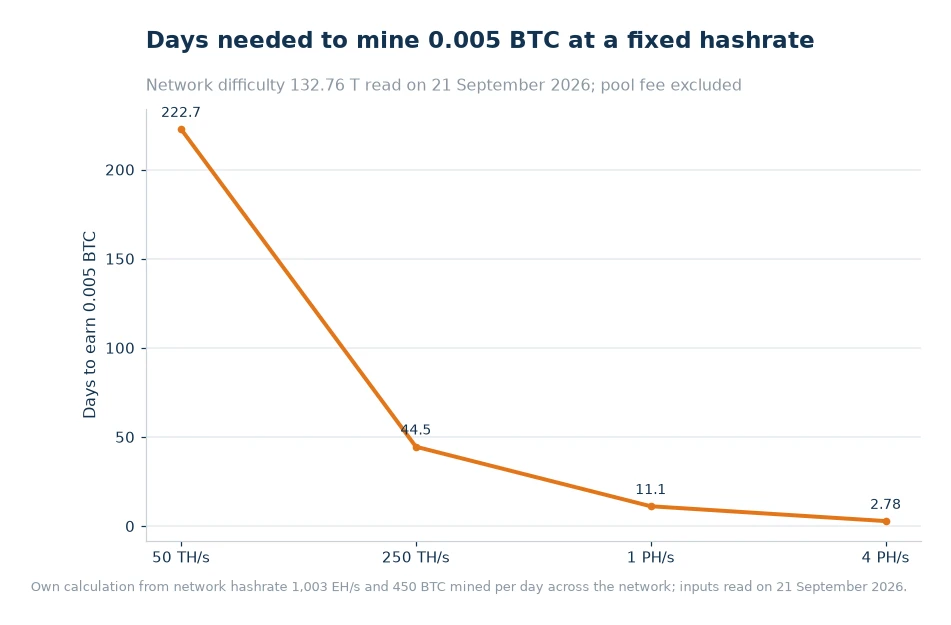
The chart makes the scale difference visible, and it also explains why payout rhythm becomes less interesting as hashrate grows. At 4 PH/s, 0.005 BTC accumulates in under three days, so even a lumpy PPLNS distribution smooths out over a month. At 50 TH/s the same target takes around 222.7 days, and one dry stretch can dominate a quarter. Before sizing a purchase or choosing a mode, check the model against current price and difficulty with a miner profitability ranking: it shows which machines still clear their electricity cost at today's numbers, which is the constraint that matters more than any pool comparison.
One more figure is worth carrying in your head. To earn a target amount inside a fixed window, the hashrate needed scales linearly: the numbers above assume nothing changes, and the network will keep adding hashrate. Recomputing on the day matters more than picking the perfect pool on paper.
Practical next steps
- Compute your share of the network. Divide your hashrate by approximately 1,003 EH/s and multiply by 450 BTC a day. That is your ceiling before fees, and it is the only number worth forecasting.
- Then choose the payout mode by cash-flow tolerance. Hourly settlement under PPS+, or distribution after six confirmations under PPLNS with a lower listed fee and reward variance on your side.
- Check pool statistics before anything else. Network hashrate, difficulty and per-coin miner counts from the pool's mining statistics page tell you whether the pool's share of the network is stable or moving.
- Watch effective hashrate, not price. A gap between reported and effective hashrate is the only income leak you can fix in an afternoon.
- Re-run the arithmetic after each difficulty adjustment. The next one was estimated at about -2.12% when these figures were read; the direction matters less than the habit of updating.
Frequently asked questions
How often should a miner check pool statistics?
Weekly is enough for cash flow, daily if you are reconciling worker uptime or chasing a hashrate fault.
Does the payout method change my average income?
It changes the variance and the fee, not the underlying expected value: your share of network hashrate still sets the ceiling.
Does joining a bigger pool increase my earnings?
No. Expected earnings depend on your share of network hashrate, which a pool does not change. A larger pool reduces payout variance and settles more often, which is a cash-flow benefit rather than a higher average.
The number to remember
If you only track one figure, track your share of network hashrate: everything you can honestly expect follows from it. Pool hashrate is a rhythm setting, payout method is a fee and variance decision, and hardware efficiency decides whether the whole exercise clears its electricity bill. Compute the share, revisit it after each difficulty adjustment, and treat pool choice as the operational preference it actually is.
Data and sources: ViaBTC pricing[1], public chain difficulty data and ViaBTC's published mining guides[2]. Network difficulty (132.76 T), network hashrate (about 1,003 EH/s), the 3.125 BTC block subsidy, BTC at 84,692 and the estimated -2.12% difficulty change were read on 21 September 2026, and every figure in this article is derived from those inputs; values move with difficulty and price.