On a small perfume order, packaging cost is rarely driven by the unit price of the bottle. It is driven by the fixed charges around that bottle — the mould, the screens, the setup, the minimum run — spread across a small number of units. Understanding which lines are fixed and which are variable is the difference between a budget that holds and one that doubles between quotation and delivery.
Key takeaways
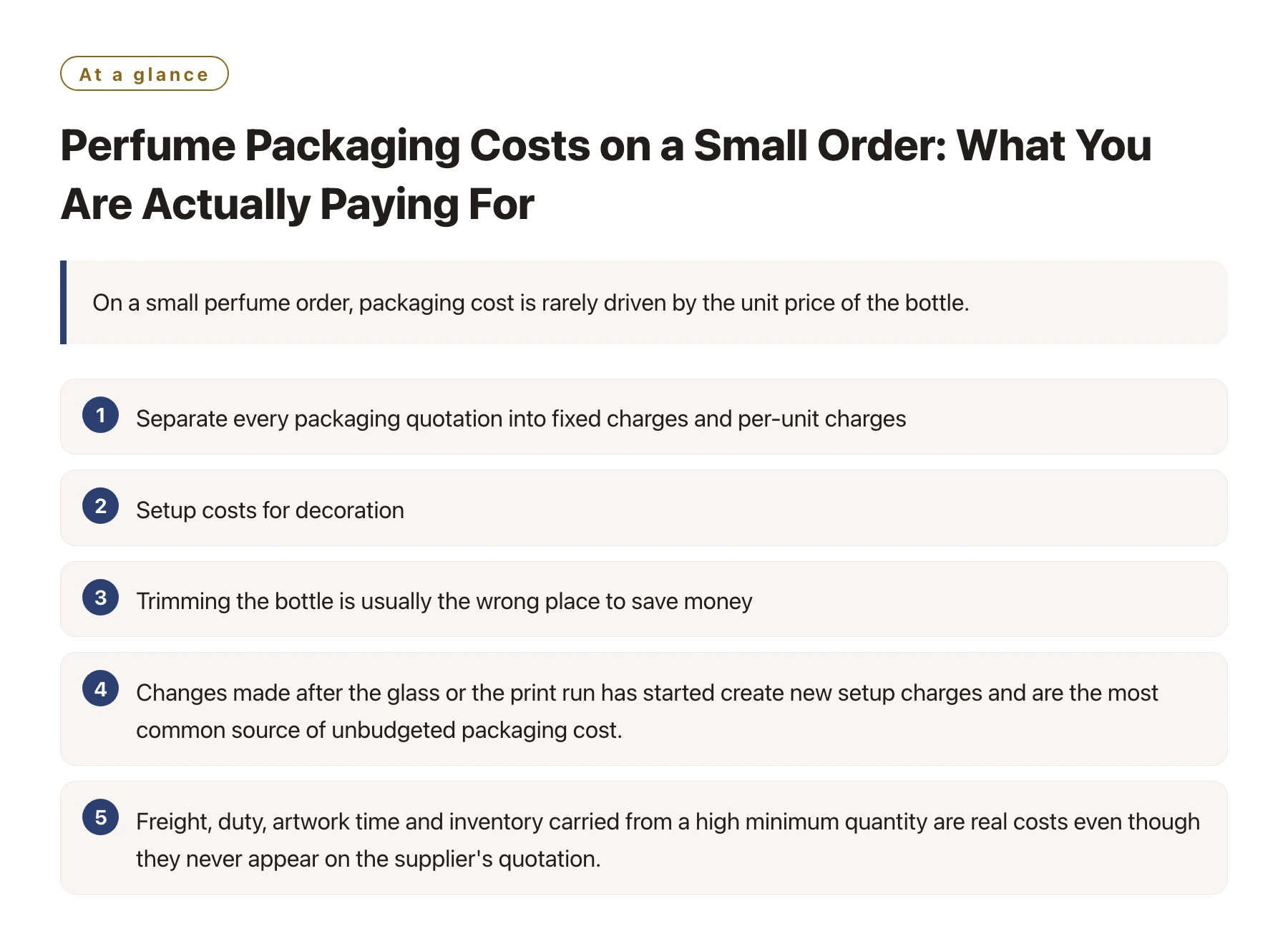
- Separate every packaging quotation into fixed charges and per-unit charges, because only the per-unit part improves when volume rises.
- Setup costs for decoration, print screens and moulds are the reason a small order can cost more per bottle than a large one; asking for them as named lines makes that visible.
- Trimming the bottle is usually the wrong place to save money; trimming decoration passes, carton weight or insert complexity is usually the right one.
- Changes made after the glass or the print run has started create new setup charges and are the most common source of unbudgeted packaging cost.
- Freight, duty, artwork time and inventory carried from a high minimum quantity are real costs even though they never appear on the supplier's quotation.
Packaging budgets go wrong in a predictable way. A brand receives a per-unit price, multiplies it by the order quantity, adds a shipping estimate, and treats the result as the packaging cost. Then the decoration is changed once, the minimum quantity forces a larger glass buy than planned, and the freight turns out to be based on volume rather than weight.
None of those events are unusual, and none of them are hidden on purpose. They simply are not visible in a per-unit figure. The way to see them is to ask for the quotation in a different shape.
This article sets out that shape: the cost lines worth separating, which ones scale with volume, and where a brand can cut without making the product look cheaper than it is.
The five lines a packaging quotation should show
A useful quotation breaks the pack into the container, the closure, the decoration, the label or print, and the secondary pack — with a separate note of any one-off charge attached to each. When those five lines exist, a buyer can compare two suppliers honestly, because it becomes clear whether the difference sits in the glass, the pump, the printing or the carton.
A quotation that arrives as one number is not necessarily a bad quotation. It is simply not yet a comparison. The request for a breakdown is a normal part of professional sourcing, and it is also the point at which the buyer learns which part of the pack is consuming the budget.
Two further lines belong in the same request. Where a market requires test reports rather than the manufacturer's own declaration, independent laboratories provide that testing for cosmetics and personal care, and it is a real cost in the project rather than an administrative formality [1]. Documentation and testing should therefore be quantified at the same time as the pack, not discovered after the pack is approved.
Why the breakdown changes the conversation
Once the lines exist, the negotiation stops being about a discount. It becomes a series of specific questions: can the closure be a stock item, can the decoration be done in one pass, can the carton be a lighter board, does the label have to be foil. Each of those has a real answer and a real price, which is a much better position than arguing over a single blended number.
Fixed and variable, and how each behaves
| Cost line | Fixed or variable | Behaviour as volume rises |
|---|---|---|
| Bottle mould or tooling | Fixed | The charge stays the same and shrinks per unit |
| Glass or container unit price | Variable | Falls with volume, often in quantity bands |
| Print screens and decoration setup | Fixed per design | Each additional design adds its own setup |
| Decoration work per unit | Variable | Broadly flat per unit; more passes cost more |
| Label printing | Mixed | Setup is fixed; the per-label price falls with quantity |
| Carton and insert | Mixed | A new die is fixed; board and assembly scale with units |
Read the first and third rows together. A brand ordering a small run with three decoration designs pays three setups, and those setups do not care how many bottles are in the order. Reducing the number of design variants is often the single largest saving available on a small launch.
Where trimming is safe, and where it is not
The bottle is the part of the pack that consumers hold, and it carries most of the perceived quality. Making it thinner, lighter or less well finished tends to be noticed immediately, while the savings are modest. Decoration passes, carton weight, tissue, inserts and the number of printed variants are much better candidates: they can be simplified without changing how the product feels in the hand.
A second safe saving is standardisation. Using one closure across two sizes, or one carton dimension across a range, reduces setups and lets the brand negotiate a better unit price on each component. Brands that plan a range from the start usually spend less on packaging than brands that launch one SKU and then add sizes piecemeal.
A third is to buy the minimum quantity that the launch genuinely needs, and no more. A lower unit price at a higher quantity is only a saving if the extra units are sold rather than stored. The cost of capital tied up in unsold bottles, plus storage, frequently exceeds the discount that motivated the larger order. Buyers comparing pack options across several suppliers often find that reading a perfume price breakdown is the fastest way to separate a genuine cost advantage from an accounting one.
How to request the breakdown so you can use it
- Ask per pack variant, not per productOne line per bottle plus decoration combination; a range with three variants should generate three sets of numbers.
- Ask for the one-off charges separatelyMould, screens, dies and any artwork preparation should appear as their own fixed lines with the quantity over which they apply.
- Ask for the volume bandsRequest the unit price at two or three quantities so the effect of scale is visible before you commit to a number.
- Ask which lines change if the artwork changesThis identifies the parts of the pack that are cheap to revise later and the parts that are expensive to touch once the run has started. A supplier offering fragrance manufacturing under one roof can usually answer all four questions in a single document, which also makes the comparison quicker.
Budget for one artwork revision and one decoration change, even if you do not expect either. They are the two events that most often push a packaging budget over, and a reserve set aside for them costs nothing if the project runs cleanly.
The packaging costs that never appear on the quotation
Four items routinely sit outside the supplier's price. Freight is billed on volume as well as weight, so an oversized carton or an unnecessary insert costs money on every shipment. Duty and import charges vary by material and origin. Artwork time is a real cost when it is spent on revision rounds. And inventory carried because a minimum quantity was larger than the launch needed is a cost that only appears in the accounts months later. The same logic governs larger projects, which is why buyers preparing to scale often start by understanding the cost drivers in custom fragrance wholesale rather than by renegotiating the unit price.
A manufacturer that also develops and fills the fragrance can sometimes reduce the first of those by planning the pack around the shipping format rather than around the shelf alone. That is the kind of conversation worth having with a partner such as Xuelei Perfume before the pack is finalised, because the shipping decision is cheap to make early and expensive to make late.
None of this means a small launch cannot have good packaging. It means the budget should be built from the fixed charges upward, with the variable lines clearly attached to the volumes actually planned. Packaging also has to satisfy the rules of the market it enters, and industry bodies such as Cosmetics Europe publish material on how cosmetic products are regulated in Europe, which is a useful reference when a pack format is being chosen [2].
Sources
- SGS: Cosmetics, Personal Care & Household Testing —— Testing, inspection and certification services for cosmetics and personal care, including microbiological, stability and safety testing aligned with cosmetics GMP.
- Cosmetics Europe —— The European trade association for the cosmetics and personal care industry, publishing guidance, positions and market information.
Frequently asked questions
Why is packaging such a large share of cost on a small perfume order?
Because several packaging charges are fixed: moulds or tooling, print screens and decoration setup do not shrink when the order is small. Spread over a few thousand units they dominate the unit cost, while at high volume the same charges become a minor line.
Should I choose a stock bottle to save money?
A stock bottle is usually the cheapest route on a first order and it removes the tooling line entirely. The trade-off is that the same shape may be used by other brands, so the differentiation has to come from decoration, labelling and the fragrance itself.
How much cheaper does a larger order make each bottle?
There is no single answer, because the saving depends on how much of the original cost was fixed. Ask your supplier for unit prices at two or three quantities; the shape of that curve tells you whether doubling volume is worth the extra inventory.
Is it cheaper to decorate the bottle or to use a label?
A label is usually cheaper and more flexible, since the artwork can change without touching the glass. Direct decoration generally looks and feels more premium and costs more per unit, with an additional setup charge for each design.
What should I hold back in the budget for changes?
A reserve covering one artwork revision and one decoration or component change is a reasonable planning assumption. Both events are common after the first physical sample is reviewed, and both typically trigger a new fixed setup charge.