Picking Panel Thickness by Load: 21 mm and 18 mm
Two thicknesses cover most black film panel work: 21 mm as the best-selling specification and 18 mm close behind it, with 1250 × 2500 mm the most requested format. Load, not habit, should make the choice, and the same panel is bonded with melamine and quoted against a 10 Hours Boiling Test. Here is how the decision works in practice.
Key takeaways
- 21 mm is the best-selling thickness for European buyers, followed by 18 mm.
- The 1250 × 2500 mm format is the most requested size in this product family.
- Bonding is melamine, quoted against a 10 Hours Boiling Test.
- Published reuse under normal site conditions runs roughly 3–5 times, so plan the cycles before ordering.
Two thicknesses do most of the work
Most jobs never need a third option. A 21 mm panel carries the load on foundations, walls and slabs where concrete pressure is highest, and an 18 mm panel covers the majority of wall and column work at a lower cost per sheet. Being able to move between the two without changing supplier keeps a site's panel pool simple.
What makes the economical family attractive is not only the price per sheet but the fit between thickness and reuse. A contractor who knows the programme runs four pours does not need a heavy, premium sheet built for twenty; the calculation changes when the panel is chosen for the number of cycles it will actually see. A Black Film Faced Plywood specification is therefore written as two lines rather than one: 21 mm or 18 mm for the load, and a reuse estimate for the programme.
21 mm as the best-selling specification
The published guidance is direct: 21 mm is the best-selling thickness for European buyers. It suits foundation and heavy wall formwork, where pour heights are large and the pressure at the bottom of the form is at its highest. A thicker section resists that pressure with fewer bearers and less back-propping.
Buying the best-selling specification also has a scheduling advantage. A thickness the mill presses constantly is easier to slot into a production run than an unusual one, and a format the mill ships every week is easier to replace mid-project if a pack is damaged on site.
18 mm where the lighter option fits
18 mm follows 21 mm in the published order of demand, and it earns its place on lighter work: shorter wall forms, repeated modular pours and sites where the panel will be handled frequently. The weight difference is felt by the crew as much as by the structure, and a panel that is easier to strip and clean tends to survive more cycles in the same condition.
Mixing the two thicknesses in one project is common. Contractors typically hold a heavier stock for the low, heavily loaded pours and a lighter stock for everything above, which keeps the cost per square metre of formwork contact under control.
Pallet planning follows the same format. In the 1250 × 2500 mm size, a pack of 40 panels is 40 × 3.125 = 125 m² of surface, which is a convenient unit for a small wall: two packs cover 250 m², and the site can count coverage in whole pallets rather than in loose sheets.
| Item | Published detail | Effect on the order |
|---|---|---|
| Best-selling thickness | 21 mm, with 18 mm next | Foundation and heavy wall work stay on the heavier sheet |
| Most requested format | 1250 × 2500 mm | 3.125 m² of surface per sheet, easy to plan in pallets |
| Core | Acacia veneers from Vietnam plantation forests | Stable core behaviour under repeated handling |
| Bonding | Melamine, quoted at approximately 10 hours boiling | Suits normal site moisture rather than permanent wet duty |
| Reuse | Typically about 3–5 times in normal site conditions | Sets the volume needed for a given number of pours |
What melamine bonding and the boiling test tell you
Melamine bonding is the specification behind this panel family, and it is quoted against a 10 Hours Boiling Test — a standard way of describing how the glue line holds up when the panel is exposed to heat and moisture together. The number is a benchmark for the bond, not a statement that the panel is meant for permanent water contact.
Read alongside the reuse figure of roughly 3–5 cycles, the boiling test positions the panel accurately: an economical sheet for site conditions, with edges that still need sealing and a concrete face that still needs cleaning between pours. Treating it as a heavy-duty premium panel is a mismatch of expectation rather than a fault in the product.
Worked example: panels needed for a four-pour programme
Take the most requested format first. A 1250 × 2500 mm sheet works out to 3.125 m². A wall with 420 m² of formwork face needs 420 ÷ 3.125 = 134.4 panels, or 135 panels for a single use of every sheet.
Example only: with published reuse of 3–5 cycles, the same job can be run with far fewer sheets. At four cycles each, 135 ÷ 4 = 33.75, so 34 panels cover the whole wall — the same coverage, roughly a quarter of the panel count, and four times the handling before retirement. If the site expects only two pours, the same arithmetic gives 135 ÷ 2 = 67.5, or 68 panels, and the 21 mm specification is then worth the extra cost per sheet because it survives handling better at that thickness.
The checks that run before shipment
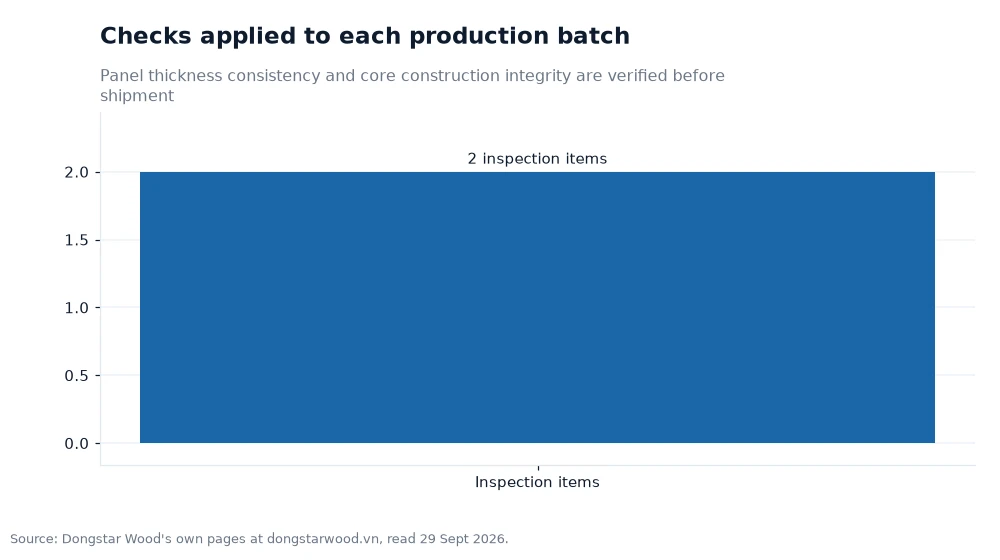
Production for this product family follows a defined sequence: moisture-controlled drying, multi-layer panel assembly, high-pressure hot pressing, plus quality inspection before as standard shipment. Batch inspection then covers panel thickness consistency and core construction integrity — two checks that matter most on an economical sheet, because they are where a lighter build shows its limits.
Ask for that record with the shipment. Thickness consistency protects your bearer spacing assumptions, and core integrity is the first thing to verify if a panel behaves differently from the sample once it reaches site.
Frequently asked questions
Should I buy 21 mm or 18 mm for a first order?
Choose by pour height and by load. Where forms are deep and pressure is highest, the 21 mm best-seller is the safer starting point; for repeated lighter wall work, 18 mm keeps the cost per square metre down. Many contractors stock both and assign them by elevation.
Does the boiling test mean the panel can be used permanently wet?
No. The 10 Hours Boiling Test describes how the melamine bond performs under heat and moisture as a benchmark. The panel suits normal site conditions with sealed edges and a sensible cleaning routine, not continuous immersion or permanent exposure.
How many times can one sheet be reused?
Published guidance for this economical family is roughly 3–5 times under normal site conditions. The range widens or narrows with edge sealing, how carefully the concrete is cleaned off between pours, and how the panels are stored between uses.
Getting the thickness decision into the order
Write the thickness, the format and the core into the specification, then check what the heavier premium option would cost before you decide. Buyers comparing the two usually start with the factory's production profile to confirm which lines run heavy formats, and with the higher-grade film panel options when a project needs more than five cycles per sheet.
Thickness, bonding and reuse figures above come from the manufacturer's own pages, as consulted on 29 September 2026 and taken for the table above and taken for the table above and taken for this article[1].